Tuesday, April 16, 2013

The Cabin in the Woods (2011)

Artwork for Theatrical Release
My first foray into film fandom was through the prism of early slasher films.  Pictures like Halloween (1978) and Friday the 13th (1980), that admittedly, I admired more because of my infatuation with a secondary school paramour more so than because of any ingrained appreciation.  That notwithstanding, my first attempt at screenwriting was a horror film, and for years, it remained one of my favorite genres until the aftermath of Scream 2 (1997),  when horror films seemed to continue to not take themselves seriously, and then out of nowhere, too seriously.

Gone was the subtlety, the inventiveness, the creative stories, and to a certain degree the implausibility which, to me, made slasher films really enjoyable.  How far can you push a slasher before he enters that weird chasm between mythology and reality where nothing survives.

Naturally, and along with the rest of cinema, horror films moved harshly towards perceived reality, and with it, I lost the enjoyment.  The Saw franchise was too pathological, and the reinventions of those long established franchised, though enjoyable and well made, lacked the crude joi that I had come to clamor.

So it was with great trepidation that I took the advise of a friend, and High School film teacher, to sit down and give this film a chance.

Not knowing what kind of movie this would be, I sat down, and was utterly surprised.  It was quirky, and smart, and funny, and well-written, and well-shot, and ultimately very enjoyable, even if the last shot was too much, even for me.

Artwork for Theatrical Release
The film is easily a cross between a slasher film and The Hunger Games (2012), as seen through the lens of reality TV, with the added sprinkling of surrealism just for 'ships and giggles.'  The film manages to put all previous genre strict horror oeuvres in the spectrum of not just thrillers, but snuff film for what appears to be, early on, gods or monsters.

An interesting homage to the horror films that have plagued the film psyche for the last forty years, and a rebuke if not rebuff of modern gore films.  Giving each their rightful place in history, but less so a penchant than a poignant restructuring of the genre, into whatever might come.

Hopefully someone is listening.

Naturally, almost as a convention of the genre itself, some of the directing, specially at the beginning, is ill-timed or ill-planned, and it affects the acting and editing, making for a couple of cringe-worthy moments in an otherwise easily digestible film.

The mise-en-scene is pretty good, particularly the mason jars full of specimens at the gas station and some of the paintings in the cabin, which are both a warning of what's to come, and as guttural as the film gets.

The editing seems to have no economy of reason, and again here you can see either the powerlessness of the director of the superstructure of a studio.  The editing finds itself often duplicating action and stretching sequences for no apparent reason, which is perplexing, but then again maybe adds to the brilliance of the whole, because I ultimately don't mind it.

Some of the acting is really bad and forced, blame the director on this one if for no other reason than for letting it go, while some of the other acting seems so natural and brilliant enough to carry the film and the interest of this cinefile.

The tonality is great, with a phenomenal play between lights and dark, which is a note to people trying to shoot digital who forget that digital capture tends to loose the richness of those dark hues and must be substituted or manipulated in post.  Those early films were shot in film, and apart from other tendencies and idiosyncrasies, there is nothing like film when it comes to playing with dark tones and highlights, but here, digitally I might add, the film-makers were able to recover that feel, although the deep rich darkness makes it impossible to watch the night scenes during the day, even with the curtains drawn.

Film Still

All of this leaves you weirdly conflicted, wondering why you're rooting for both the protagonist (Kristen Connolly) and the people at master control; and at the same time rooting for the ancients as well.

It is not what you expect, but exactly what you need to refresh your faith on a genre that had seemed to go astray since the humorous homage of the original Scream (1996) film.  Like the later movie, Cabin is unapologetic in it's semblance of humor and horror, even if it falls more on the other end of the thriller spectrum, closer to pure horror.

The third act is as unexpected as anything I have ever seen or expected to see here, and suddenly the rousing triumphant musical score from the previous two acts seems meaningful and well thought out, even if the bad acting and bad decisions of the first act are still inexcusable.

Maybe.

The rogue gallery of monsters, archetypes, abominations, mythical creatures, and tried and true fear inducing horrors are classic and apropos, as if Resident Evil (2002) and Thir13en Ghosts (2001) had a set of babies, and those babies had chronic nightmares, and the manifestations of those dreams were but a minute spec in the universe that is this universe.

It is the right amount of psychosis, pathology, masterful homage, insightful reflection, and just sheer joy.

I did not expect to like this film, and I most certainly did not expect to be enamored, but here I am.

Buy this film, it's worth owning, otherwise rent it on Blu-ray, I fear the dark tonalities might not show up as well on DVD.

Wednesday, April 10, 2013

Definitely Maybe (2008)


Artwork for Theatrical Release
In the hundred plus years of film's existence, no genre, safe for perhaps the documentary, has been more incendiary as the romantic comedy.  It is often frilly, and cliche, and repetitive, and simple, and for the most part horribly constructed and poorly executed.  This doesn't keep half of the population, myself included, from loving these films, and the other half from using it's presence as a reason to revolt.

But hidden behind the generality of its frivolousness, there are some brilliant gems, like the chemistry and hilarity between Meg Ryan and Kevin Kline in French Kiss (1995) or the raw acting and dorky sexuality of Emma Stone and Ryan Gosling in Crazy, Stupid, Love (2011).

It is within these parameters that I've supplanted the popularly forgotten Definitely Maybe (2008), the rare romantic comedy that is smart enough to make politics, and more so the antithesis of romance in the Clinton era, the overarching notion in the plot, and doing it well enough to be enjoyable and organic.

The brilliant ensemble cast has much to do with its success:  The academic Summer Hartley (Rachel Weizs), the troubled genius Hampton Roth (Kevin Klein), the very Midwestern singularly named Emily (Elizabeth Banks), and the enchanting, enthralling and equally mononymous rebel April (Isla Fisher) are all at their top acting form, which is a breath of fresh air for genre lovers that are all too accustomed to top tier actors cashing their checks and then phoning it in.
Film Still

The chemistry between the precocious Maya Hayes (Abigail Breslin) and her father, the oft-misguided but ever disarming Will Hayes (Ryan Reynolds) is engaging and goes a long way towards making this story not just enticing, but also enjoyable and really funny.  And that's no easy task considering the conversations are often peppered with very grown up relationship motifs such as threesomes, thrusting motions and penises.

The script goes a long way towards the beauty of the film.  It takes a very elaborate concept, and an often hectic pace and sprinkles it with the right pauses and the perfect hilarity to make the film feel less overwhelming than it otherwise should have been and never bogged down by the political and romantic points of the narrative.

The script is aided by the mostly conventional camera work which if nothing else, doesn't detract from the characters, which is not to say that there aren't any beautiful or imaginative shots, there are, and when they come, they are very eye opening.


The editing quality drops at times, particularly in the middle, but otherwise stays consistent and inconspicuous.

The film itself takes the basic concept behind How I met Your Mother (2005), or maybe it was the other way around, and combines it with the precociousness of the little girl from Jersey Girl (2004) minus Ben Affleck and Jennifer Lopez and comes out with a film that should be rightfully added to the annals of cinema.

Ultimately it ends up with a really good 'ode to the biggest little village in the world, and the interconnectedness and the loneliness, and the excitement, and the opportunities, and the climb and the fall and all the things that make people fall in love with NYC.

If you're a fan of this genre, or of any of the actors, or even if you're on the fence with any of them, catch the film in any way you can, you won't regret it.

Wednesday, March 27, 2013

Les Miserables (2012)

Artwork for Theatrical Release
By now you've made up your mind on this film, and let's face it, without a single spoken word or utterance, it's a hard sell to anyone but the most diehard fans of musicals or the stage version proper.  But not watching this film would be an absolute mistake, even for the most casual of film fans.

The much mentioned live singing (sometimes with anachronistic errors to boot) is phenomenal, and lends a raw sense to the acting, even if that means the audience has to get used to less than stellar singing, but that's the point.  This musical is closer to Hair (1979) and Cabaret (1972) in logic and aesthetic than to Moulin Rouge (2001) which covers approximately the same geographic space, even if 30 years later.  It's supposed to feel like a dramatic film that happens to be put to music.

That same raw aesthetic though, tricks the camera work into the tightest of corners.  Requesting that it work in an ever more quickened pace, sometimes forcing it to assimilate to the selfsame mistakes that culminate on some of the flaws of the film, regardless of whether you liked them or not.  Case in point, the focus seems to be a problem during some of the closeups, to the point of being a nuisance, and it doesn't appear to be a stylistic choice, which is a shame for a film that uses the close-up so much, ridiculously so.  But in the raw unnerving nature of the scenes you don't really care to question it, and maybe that apropos act is the point.

The singing is good, and some of it, specially Anne Hathaway, is phenomenal.  Full of coarse, gut clenching emotions that heighten the narrative and tugs at heart strings that were not there before.  Particularly with Ms Hathaway and the very humanized Hugh Jackman, the acting/singing has a quality that rips you past their celebrity clad status to the point of sympathetic projectionism, and that's the most vulnerable of all those plucked strings.

Artwork for Theatrical Release
Apart from the over-use of the close-up the cinematography is spotless, and let's face it, with a musical staged in such a grandiose place as revolutionized Paris, one would expect alot more of an epic feel, but the film here feels more like a introspective experience, and less so an overt musical.  But again, I think that's the point, regardless of whether you like it or not.

The color palette, the least resigned of the cinematography, is beautiful, and appropriately gloomy, taking the gloom and doom of a Burton film, and adding the muted colors of the French Revolution.  The pale blues and yellows of the iconic forget-me-nots and the red of the blood to be spilled are ever present and automatically place the film in its proper context, even if the audience can't exactly ascertain the motives.

If you're a fan of Hugh Jackman, Anne Hathaway, musicals, or Oscar bait, than buy this film on Blu-ray, it's worth the extensive analysis. 

If you're just a casual fan, or don't want to miss out on future cultural references, than rent this out if you can manage to get your hands on a copy in a timely fashion. 

Either way, whatever you do, try to avoid any online streaming method, it's really not worth the compression issues and the digitized packets of the dark aspects.

Monday, February 25, 2013

The Hobbit: An Unexpected Journey (2012)

Artwork for Theatrical Release
I never intended to do it, trust me.

I never grew up reading Tolkien. 

The closest I ever got to The Lord of the Rings, were my friends, who did nothing else but talk about their almighty, Tolkien.  But I thought they were weird - an apropos kettle judging.  But then I fell in love with Peter Jackson's Lord of the Rings universe.

I still don't want to read the books, but I love the films, and the starting salvo of The Hobbit trilogy is really no different, even if the flabbergasted notions are not as present as they were for The Fellowship, The Two Towers and for The Return of the King.

Like the earlier installments, this film is ridiculously epic and grandiose, with an incredible amount of attention to details that exemplifies Peter Jackson's filmmaking in its modern stasis.

The art-direction and cinematography are proper to the established cannon, even when it augments greatly and beautifully.

The compositions are phenomenal, with the right play of shallow depth of field, colors and textures that make for very traditional Hollywood filmmaking, but whose determinism and pristine presentation is intense and a joy to watch.

Martin Freeman as a younger, more neurotic Bilbo Baggins is good, really good; full of the quirks that make for great acting.  His Baggins is more frantic and troubled than Ian Holm's more sedentary, more secretively adventurous Bilbo.

The audio design is good, swelling the music and going silent when needed, mixed, in turn, with the expected nuances that have become the battle hymn of modern action/sci-fi soundtracks.

Artwork for Theatrical Release
The locations do not disappoint.  They are simply stunning and the camera work properly accentuates the beauties and minutia of each location, highlighting of minimizing previously used locations.  Always showcasing the sheer beauty of it all.

Gollum (Andy Serkis) is even more realistic and creepier and scarier than you remember, but even so he's a million times more fun to watch.

The film is even more beautiful than The Lord of the Rings trilogy, and believe me when I say it took me a long time to write that.  But the film here seems more methodical.  More layered.  More purposeful, and less overly dramatic.  Although, having said that, it probably has a lot to do with the fact that there is more action than in The Fellowship of the Ring, and less frenetic sequences than The Two Towers and The Return of the King.

If you're not a fan of the films, skip it; even if that isolates you from cultural references.

If you are a fan, even a casual one, catch it on Blu-ray, it's stunning visually.

Thursday, January 3, 2013

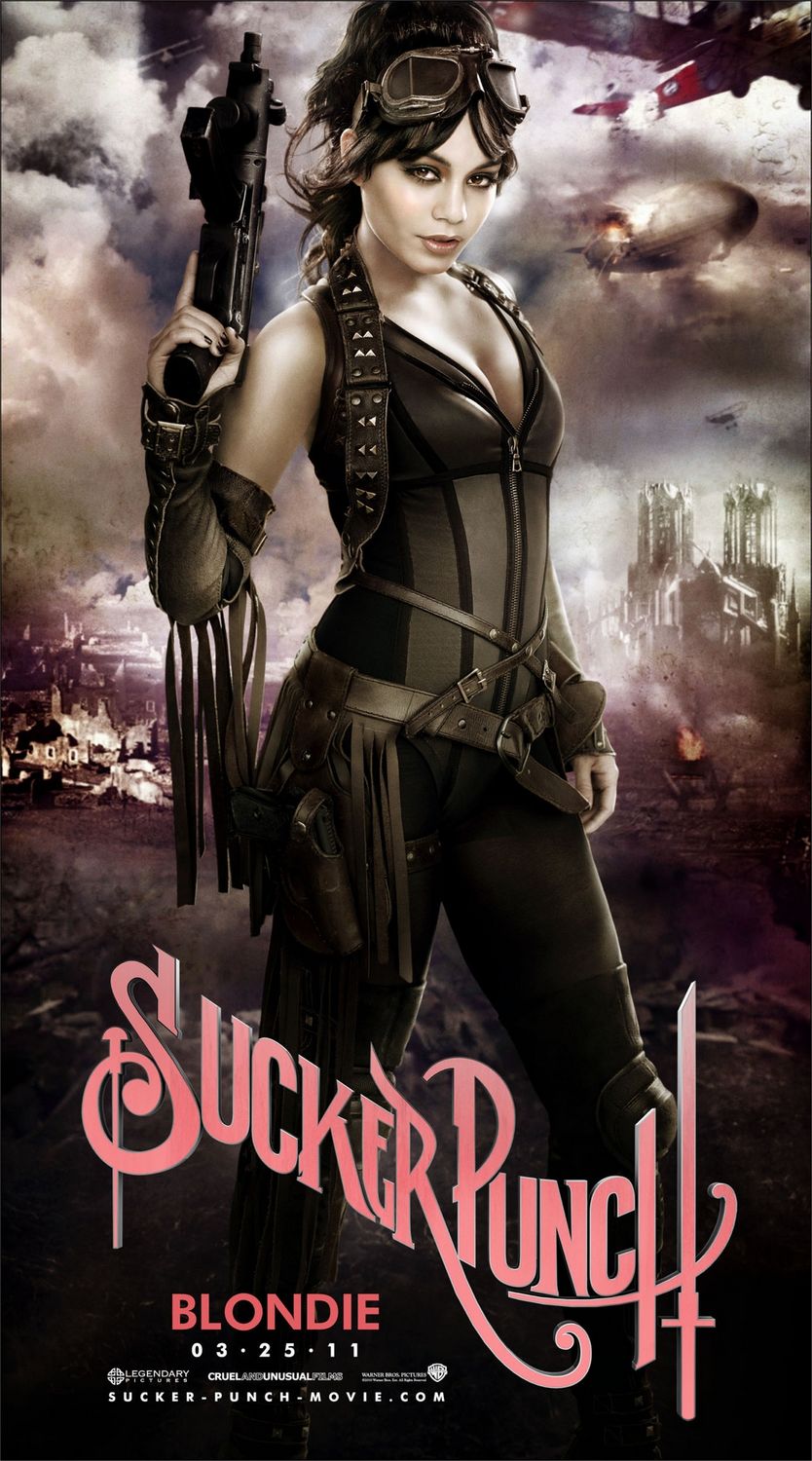
Sucker Punch (2011)

Artwork for Theatrical Release
By definition, a guilty pleasure must be both, enjoyable and at the same time embarrassing.  My wife has her regrettably bad film choices (B-films, or more precisely, the really bad B-films that populate the bottom of most discount bins) and I have mine, ever more regretful choices.  Sucker Punch falls heavily on this list, because even though it is striking in presentation, a film like this in any other metamorphosis, would be horrible and unwatchable. 

Or maybe not, if you're my wife.

Setting the pace for most of the film, in substance and sustenance, the intro is very dreamy, yet adrenaline packed, mostly thanks to the music and specifically Emily Browning's haunting rendition of the 80s super-frivolous "Sweet Dreams," shallow camera focus, desaturated colors, and changing camera speeds that flow from slow motion to fast motion to regular, with the ebb and flow required to make all these otherwise disparate elements function.

The music sensibilities remind me a lot of Bjork's trance inducing rhythms, here presented by the before mentioned Emily Browning and Emiliana Torrini who performs an incredibly delirious "White Rabbit," a song made famous by Jefferson Airplane [Monterey Pop (1968)], among many other cryptic singers including Bjork herself.

Artwork for Theatrical Release
There are some truly and honestly inspiring compositions in the film, which, if filmmakers could get beyond the gloss, over-sexualized and hyper-violent nature of the film, they could glean for their own purposes.  Along with Watchmen (2009), and the other crop of recent ingenue films [i.e. 300 (2006), Sin City (2005), et al], Sucker Punch seems inspired and and at the same time aspires to comic book sensibilities and aesthetics:  Which is good news for all those that were regaled by Watchmen, but somehow wished for less blue penises.
 
Having said that, this film suffers from the same problems as those earlier films, mostly the script, which here is horrible, replete with really bad exposition and bad acting to boot, particularly from Abbie Cornish (Sweetpea), although in her defense, that might be more a result of the script, and should not be counted against her.

Artwork for Theatrical Release
To make it worse, some of the battles, the main draw of the film, are very badly choreographed, including fighters on the sideline waiting, out of character, for a strike to be dealt before moving on to their next cue, and some of the traditional New-Hollywood use of badly wired stunts, which look horrible in their weird contortions of the human body.

Sigh!

Suddenly, towards the end of the film, I remember this film leaving me with an empty unfulfilled feeling, and that doesn't change upon watching it again, or upon watching the extended edition.

And I will, alas, watch it again.

Forgo the extended edition since it adds absolutely nothing to the narrative, unless you find it at a discount like I did, otherwise watch it on Netflix (if available) or rent it.  Avoid network or cable TV viewings though, since the main draw seems to be the hyper-sexualized and scantly-clad lasses, whose contributions to the film, might be diminished through fear of litigation.

Monday, December 31, 2012

Dancer in the Dark (2000)

Artwork for Foreign Theatrical Release
It's been over a week and the utterly depressing aura around this film is still heavy upon me, so viewer beware.

From the very beginning, this film moves to straddle between nostalgia and a weirdly disassociated emotional spectrum with a very haunting and mesmerizing sequence, an homage to the films of Golden Age Hollywood that would start with abstract shifting coloration while the score swelled in the background.

It is a strikingly beautiful film, full of gorgeous and rich, even if bleak, art-direction and compositions.  Almost entirely achieved through the heavy use of close-ups and medium shots, with no establishing shots whatsoever, which, here, I don't mind at all.  And that's rare.

One of the most striking things, is the way the sound is edited and mixed to create a 3D space, even through the prism of a stereo speaker, with sound sometimes emanating from behind, forcing me to jump and question my sanity, and consequently that of the characters and filmmakers.
 
The compositions are a direct response to the fact that the film seems to have been almost exclusively shot with one camera and improvised, making retakes and b-roll an impossibility.  This in turn forces the editing to be jaunting, abrupt, and as far from textbook clean editing as possible.  But the film draws from this disjointedness instead of suffering at the hand of it, creating an ingrained sense of sadness and depression.

In this task, the camera work and editing are aided by the palette of a very dry and bleak cinematography, completely devoid of color and full of textures and patterns, which although the film doesn't specifically pinpoint the location, places itself somewhere between the back hills of Appalachia and the Midwest of the Dust Bowl.

Speaking of things undefined, there's a very nostalgic, weirdly unnervingly so, feeling to the film, which is never resolved.  Leaving one to question what the filmmakers are trying to make us nostalgic for and why? Is it the 1950s, playing card in bike spoke and all, or is the narrative caught in the weird flux of time that seems characteristic of factory towns raptured from their long gone affluence?

Artwork for Foreign Theatrical Release
For people who grew up with two memories of Bjork, an eerie voice and a swan dress, here her acting really shines, which is no easy task considering the stellar performance from the entire cast.  Her character struggles between being simple and complex, strong and weak, feminine and masculine, victim and stubborn cause of her own complications, like a weird Sisyphus trying to fight a rock she can't see or comprehend.  A good wounded bird and despot, a depressing protagonist, and a relatively hard one to stomach through her faults.

This film is painful, even before the inevitable end, a truly gut-wrenchingly painful film that had me not just crying, but bull blown bawling!

I hate whoever told me to watch this film, it's so beautiful even if cringe worthy, a la Shame (2011).

Go rent this film, it's worth hunting down, just make sure you're in the mood for it.

Friday, December 21, 2012

Jennifer's Body (2009)


Artwork for Theatrical Release
I really have no need to watch this film other than as a guilty pleasure, and not for the reason that you think.  My guilty pleasure is not the beautiful and misunderstood in quality of talent Megan Fox, although sometimes in this film, you could see why.  My guilty pleasure is the oft mispronounced  Amanda Seyfried, and there it really doesn't disappoint.

The film is beautifully creepy, but not a thriller.  Eerie, but not a horror film.  And very sexual, although less satisfied than a badly shot porn, in laser disc.  And that maybe is the problem here, the lack of purpose and definition.

Based on the trailers attached to the DVD I watched, it seems to have been intended to be quirky and dorky and sort of counter culture, but the casting says otherwise (sans Seyfried and Amy Sedaris), and the script begs for more substance, so it falls into a weird chasm between mainstream and alternative, never pleasing anyone completely, regardless of what you go into this film hoping for.

The cinematography is good, including a really cool high angle shot of Amanda Seyfried in the holding cell both at the beginning and end of the film and an awesome and appropriate long tracking shot of a grieving football player.  Although the stunt coordination on the floating fight scene takes away from what otherwise would have been a very violent and erotic and energetic fight scene (three things I think the film excels in otherwise), and so the camerawork suffers in that because of other stakeholders.

The acting is not particularly bad, or at least not as bad as you would have expected considering the frivolous nature of the casting and marketing.  Having watched Megan Fox on many of her movies and her multitude of TV appearances, she's not really a bad actress when she's trying, the problem is that, even in this film alone as a macrocosm, there are marked differences from scene to scene and that's a shame.

Artwork for Theatrical Release
The music is enjoyable and properly suited to its endeavor.  Which is not surprising for a film designed the way this one is.  Although for most of the film, it's the music that does most of the modd setting; thrilling, sexuality and all, not the editing or the choreography of the action.

The locations are great and help set the mood of the film somewhere between the vast emptiness of The Shining () and the sanguiness of Suburban teenage life, so props to the scout.  Although, speaking of props, the models of the dead victims look atrocious.  Even worse than the toothpicks left behind in the neck of the original Friday the 13th, upon the beheading of a Vorhees.

The editing is sometimes just appalling moving the needle in the opposite direction of the desired mood.  Although as a whole, the average of the editing is just a nudge below average including some of the cut-aways that are simply stupidly unnecessary, and although I want to blame the editor, it might be the director's fault, or considering Diablo Cody is the executive producer, it might just be her fault since most of the problems seem to be structure and gimmick based.

The script is uneven, with some horrible lines and, at best, some OK ones, but no memorable ones.  Not to mention Diablo Cody never seems to have defined most of her characters, including whether Jennifer (Megan Fox) is always possessed, once bitten, and just reverting back as a means of manipulating Needy (Amanda Seyfried), or whether she's, even before becoming a Satanic morsel, straddling those lines like a stereotypical teenager.

Most of the dialogue seems fitting coming out of Amanda Seyfried in this film and Ellen Page in Juno (2007), but forced and illustriously shocking coming out of Megan Fox.  Some of the lines also seem to be Cody trying to make an unnecessary witty comment on an aspect of society, even if in a vacuum, the characters would never say that and worse yet it may be inappropriate in the situation, which is different than Juno (2007).

Artwork for Theatrical Release
The bigger problem with  the script are the HUGE plot holes, which are things that normally don't disturb me, but here they seem to jump out beyond the fourth wall, straight into that part of your brain that suspends disbelief.  SPOILERS ALERT:  Like why would the dock be wet before Megan Fox comes out of the lake.  Why would Amanda Seyfried's character (Needy) be afraid of someone knocking on her door immediately after the catastrophic and weirdly cathartic fire, when, if anything, she should be happy about the affirmation that Megan Fox (Jennifer) is safe. How the frack does Needy know where Chip, her boyfriend, and Jennifer are towards the end of the film?  And why would the jock's parents be crying on the other side of the police tape as their son is wheeled away from the crime scene.  Specially the mother who two scenes later would be described by her neighbor as being catatonic.

WTF?  (which here means...watch this film)

No really I mean it, if anything because Amanda Seyfried is brilliantly creepy once she's demonized, and would be a perfect usurper of Jack Nicholson or even as Sissy Spacek in their creepy thrilling culturally relevant acting turns, which is more than this film could aim for.

Rent this film and catch it when you're looking for frivolity and simple merriment, but just don't expect to have as much fun as you did watching Juno (2007).

Tuesday, December 11, 2012

Singin' in the Rain (1952)

Artwork for Blu-ray Release

It might seem overhyped and overblown, but this film is a fit classic of American cinema, and based on my daughter's intrinsic and immediate adoration of it on first viewing, there's also something of a primordial siren call that attracts even the most precocious of four year-olds.

To anyone who hasn't seen this film yet, the comparisons against The Artist (2011) are inevitable.  But although they share in similar gags and story arcs, this film is ever so perfect and beautiful and enticing to watch over and over again.  The same can't really be said of The Artist (2011), which although, a good and enjoyable film, its gimmicks quickly become tedious and forgetful.

Part of the charm of Singin' in the Rain (1952) might be the striking use of Technicolor, or the way significant bits of Gene Kelly's joi-de-vivre are left stamped throughout this film; and as the writer, director and choreographer, it's amazing how much of this man might just be in this film.  Leaving one to wonder just how much of it is Gene Kelly trying to make art out of an early musical (some would argue just entertainment, I would argue a mix of both), drawing a parallel between Lockwood's (Gene Kelly's character) struggle and Kelly's own.
 
In our minds, there are these films that are so full of chunks of our emotions, films that hold a special place in our cannon that we perceive as perfect, but they are, alas, not immune to the slight shake on a zoom or track or pan.  But this doesn't bother me which makes me a bit of a hypocrite for chastising modern films for their flaws.  But this film is just sheer joy, and much like an oft faulted paramour, one can forgive a hiccup or two.

Some of those hiccups are infamous, like the fact the the original negative was lost in a fire, and the only remaining version of the film has a very noticeable couple of frames missing from an otherwise pristine and beautiful long take.

An upcut and a serendipitous event aside, the film is beautiful and maintains an ecstatic pace throughout, even if during the abstract NYC ballet scene at the end of the film, you start to wonder how long it has been.  But ultimately, it just won't matter, you'll be encased in the narrative and metaphors to even care.

One of the most striking and revelatory things about this film is that it manages to be fun and full of energy, through the near exclusive use of long takes, which is hard to understand with today's fast cut, shaky cam cinema style.

Production Still for Film
For the cinema buff, there are also alot of palpable homages to early film including a chase sequence of sorts where Gene Kelly, running away from adoring fans, jumps from moving car to trolley to car and so on with no safety harness or equipment. Thanks to OSHA and safety regulations and sheer safety concerns, they would not let anyone, not even a certified loony stuntman, do these stunts now-a-days, least of all the main actor and director, which tinges the film with hints of silent film auteurs like Charlie Chaplin and Buster Keaton.

The script is really funny and complements the acting, and apparent personalities of the actors, beautifully, whether situational, dialogue based, or even physical, the script comes across and not only natural, but perfectly fit for it's purpose.

The camera work that supplements all that is phenomenal, almost like another dancer stretching its gams for the audience.  Swooping around choreographed dancers, supplanting the fourth wall, and knocking it down when needed.

The voices from all the players, whether actual or dubbed by others, are pitch-perfect and so pleasant to listen to. The namesake song, an otherwise generic song about soggy exaltation's of amorous underpinnings and its male permutation is still great and fresh, even after all these decades of cultural references and parodies, and the same can be said about "Good Morning" which my daughter already sings without realizing it.

Gene Kelly's sidekick, Donald O'Connor, is great and oh so funny, showcasing his great comedic timing, specially in "Make Them Laugh."

Artwork for Film
Even the ending is great, even if a week later, and after having watched the movie a dozen times in two years, I can't remember it clearly enough to describe it in more than one line.  All I'm left with is just an image of some of the characters in front of a billboard, which at the time of the viewing, led me to write "very 'meta' ending...a movie within a movie, that ends with the creation of said real movie, same title and all."

I wonder what I meant.

Either way, either catch a theater showing or buy this film on Blu-ray the Technicolor treatment alone is worth it.  You might have fooled yourself, but this movie is going nowhere specially having survived a fire that would have made an optimist out of any negative.  The Technicolor looks phenomenal on Blu-ray

Saturday, December 8, 2012

Skyfall (2012)

Artwork for Theatrical Release
Let's face it, by now,  you either love the Bond films or you hate them. 

For a small group out there, myself included, Casino Royale (2006) marked the turning point and the inclusion into a franchise that had been more widely known for ridiculous frivolity and the myriad of women that were apparently the kin of higher than hope hippies.

Either way, this film is really bound to make most Bond fans happy, and that's quite a feat considering how broad a spectrum that is.

In what has become a franchise signature, this film starts with an awesome adrenaline packed intro, even if it is a bit slower than Quantum of Solace (2008) and less innovative than Casino Royale (2006).  Either way it sets the pace for the second act which is much slower than would make most people happy, but it's apropos and you'll soon forget about it since the third and fourth act are phenomenal and more contemporary to the current Bond series.

The acting is great and inspired on all counts, which is also constant with the modern Bond universe.

Javier Bardem is brilliant, and chilling, and scary, and thrilling, and an all around incredible actor, twitches and all.  And Dame Judy Dench is surprisingly sympathetic and tragic in her rendition of M, which is a change, even if fleeting, from the heartless bitch she is, even at the beginning of this film.

The directing, by Sam Mendes [American Beauty (1999)], is unnoticeable, which is good or bad depending on what you look for.

The cinematography is good, even if not as palpable and guttural as Quantum, but the seemlessness of the editing more than compensates for it.  Or maybe just hides it.

Artwork for Theatrical Release
The audio design is, as expected, proper and adequate, but the constant droning music is a bit obvious and distracting at times.

The ending is great, as are the sprinkles of retro futuristic nostalgia which marks a thematic change for the Bond films in this series.  A change that might just please fans of the old Bond that have fallen disenfranchised.

Through and through, a solid package and very enjoyable, which is ultimately the purpose of all Bond films regardless of ilk.

One last thought, and it might just be me, but Skyfall reminded me, almost in every turn, of The Dark Knight (2008).  An anarchist villain, a return to basics for the protagonists, a couple of constant plot points, increasing nods to the mythos of the characters, and a brilliant 'cornered dog' sequence crescendo, and just as much fun to watch and decipher. 

Catch it in the theaters now or own it on Blu-ray, based on the IMAX print I saw, it'll be more than worth it.

Friday, November 23, 2012

Wreck it Ralph (2012)

Teaser Artwork for Theatrical Release
 Fun, plain and simple.

Not a fantastic film, not even a classic, or a much memorable film, except in concept, but a good film and a lot of fun.  So if that's what you go to the theaters for, than you'll enjoy this a lot.

Apart from some interesting art direction, and only occasionally, it is simple in cinematographic aesthetics.

Simple in plot and narrative structure, often to the point of tiresome clichƩ.

Even simple in character development, and that's really the greater sin.  I've said it before, and I'll say it again, animation cannot be a simple vehicle for clean animation any more, that's way too easy to do, even for an amateur.  And when a film is lacking originality in everything except the concept, than there's a bigger problem.  And that would be the final crux, except that I think the filmmakers could care less about legacy, and are more interested in pure escapism, and there it succeeds.


Which leads me to believe that this film was hoping to make a bucket load of money and quietly disappear into the background, so go into it with respective expectations.

Having said that it is very well done, and still manages to make you fall in love with the precocious little girl Glitch, who in a film with no goals of kid domination, would have cursed up a hell storm, and who ultimately eclipses Wreck It Ralph as the character you end up rooting for to succeed.

The interplay between real video game characters and the new characters is good, but not great, even if you end up wishing there was more to be had.

Artwork for Theatrical Release
The audio was OK, but not complex or innovative, and too traditional in sound design to matter much.

The acting was mismatched sometimes, particularly with Jane Lynch's character, but I think the fault there is more that of the animators and less of Jane Lynch herself.

The gigantic flaw in this animated tale is the seemingly huge flaw of most of its contemporary, they can't seem to handle plot exposition in any other way than slapping the audience smack in the face with it.  I don't care how the characters travel from game to game, I really don't, and once you explain it, than you open yourself to ridicule and anachronisms.

But having said all that my daughter loved it, and so did my wife:  And if nothing else, I have my Halloween costume for next year.

Wait for it to make it's way to a rental unit near you, not worth the $32 I paid for three non-3D tickets...blah!

Wednesday, November 21, 2012

The Seven Year Itch (1955)

Artwork for DVD Release

Icon seems to be overused, and it is.  And myth hints at a bit of nonexistence, which does not apply here.  But it comes as no surprise that when you watch, or even just hear the name Marilyn Monroe, there's a bit of mythos that slips through, even if you've never watched any of her films.

Although forgettable for cinematic instances, minus the famous dress instance (which as a side-note, is attributable completely to a publicity shot, since no full establishing shot is visible in the film proper), the film exudes the sort of brilliant fine line dancing exhibited by Marilyn.  Always prancing in the fine line between sultriness and innocence, sexy and next door.  Always making you wonder whether she's playing a fool, or fooling you into playing along.

And that's brilliant.

The plot is simple, and explained in the four words of the title.  The structure of the film itself is mostly steadfast to what would have been seen in the play the film is based on, at least in structure and visual impasse.


Publicity Photo for Theatrical Release
The script is good, but the main character, played neurotically by Tom Ewell, seems forced at times, although that might be a characterization more than a flaw in acting, although knowing that Marilyn was forced to shoot this film under contract and against her wishes, it makes one wonder is the same is true for Ewell.   Regardless, occasionally a glimpse of brilliance comes through, and that makes the film a lot of fun to watch.

As for Marilyn's acting, it's impossible to not be awashed by the legend of Marilyn, even if her character is a simpler, more "girl next door" person compared to the actress playing the part.  And she's just sheer joy to watch, even in the most pedantic and shallow roles.


Apart from Marilyn's sheer and utter sultriness, not even an image (just a thought, a sexy joi de vivre), it's hard to think of any other indelible images that have stuck true to my mind a week after viewing the film, and that's a shame.
Publicity Photo for Theatrical Release

The structure of the film is off, and sometimes feels too forced and unnatural. 

The ending comes too abruptly and almost against type.  The film seems to be moving in a specific direction, towards a determined outcome in narrative and theme, even four minutes before the film is over, then suddenly in the last two minutes...KAPOW!  The credits roll and you're left to ponder.  Was is the censorship boards at the studio, in society, in government.  Something, because ultimately, not having read the original play, I'm left to wonder if the jauntiness is done on purpose or forced in post-production.

Rent this film if you can, Marilyn is worth it, and you might not watch it more than once or twice.  If you're a fan though, buy it on Blu-ray, the colors are truly amazing.

Monday, November 12, 2012

Coriolanus (2011)

Artwork for Theatrical Release.

Very few people have the diligence and patience to do cinematic justice to Shakespeare, and this is even more true with one of the lesser known plays.  Which is why we have a thousand versions of 'Hamlet,' but only a few of Coriolanus.

If you are used to Kenneth Branagh's Shakespeares and their smooth, polished, traditional approach to visuals and narrative, then this film will pleasantly surprise you.

And that's the point.

It is not as perfect as one would have liked having been used to Branagh, but then again, this is Raph Fiennes.  Fiennes, in his directorial debut, manages to make Shakespeare feel immediate and contemporary, not just in subject matter and approach, but also in aesthetics and themes.

I have not been this thrilled or as excited watching Shakespeare since Julie Taymor's Titus (1999) showed me Shakespeare's sadistic, horrific side in the most visually pleasing way possible.

I hate the phrase; but now-a-days (blah) it seems like when you want to capture action, cinematographers automatically reach for the Steadicam, and air on the side of shaky compositions.  It pisses me off to no avail, because often they're really covering up for weak choreography or overdoing the intensity of the action, so that ultimately the audience can follow little of the real narrative, which ultimately is the purpose.

I see you there hiding behind your Steadicam operator Michael Bay [The Island (2005)].

You're fooling no one!

Coriolanus manages to dissuade this notion, with carefully orchestrated synchronicity between traditional fare and some of its more contemporary brethren.  The camera work is great, static with imaginative compositions when needed, handheld and claustrophobic and shaky only when dictated, and that alone deserves applause.

The art direction is flawless, seamlessly floating between modern warfare, classical pomp and rich lobbying.  Creating this otherworldly, ethereal smorgasbord of imagery that leaves you guessing the true intentions of the characters actions and the filmmaker's intentions.  Creating layers, upon layers, of intrinsically choreographed symbolism, often having esoteric arguments with the acting and script.  Not an easily garnered laurel, alas.

Fiennes's concept of the digital/physical revolution dialectical dialogue is brilliant and innovative.  Having rebels easily switch between using terse dialogue, automatic weapons, to hand combat, cell phone videos, portable cameras, and sometimes contentious use of the media machine.  Capturing very well the ebb and flow of a contemptuous mob, of a rebellion on the brink of both glory and failure, and of a protagonist that is both perfect and flawed, sometimes by the same characteristics.

The sound design is cacophonous when prudent and minimalistic in surprising ways.  Sometimes slightly altering the reverb on the voices of the characters to make them feel ominous and eerie, even if you don't understand one hundred percent every bit of poetry and prose flowing from the mouths of the actors.

As a side note:  If you have a hard time with Shakespeare, as I confess I do, watch it with subtitles.  The mix of action, visuals, and text make understanding and comprehending it much easier. If Babel (2006) has taught us anything is that you don't need to understand what the characters are saying necessarily, to comprehend the story or be impacted by it, or through it.  And that's the lesson people seem to forget when they brush these films aside simply because they don't understand the language.
Artwork for Theatrical Release.

Looking beyond the language, the color palette is very drab, including not a single crimson color.  Not in the blood, not in the sky, nowhere;  except the occasional deep forest green in Coriolanus's private world.

Some of the compositions are just beautiful and full of hubris, for the characters and the fimmaker.  Which again, is not an easy accomplishment, but Ralph Fiennes does it, and considering the complexity of his acting, one would assume almost haphazardly; but meticulousness is more like it.

The acting is beyond breathtaking, even from minor characters that serendipitously pop up on screen.

Vanessa Redgrave, as Coriolanus's mother and puppet master, is much creepier and dangerous than fifty Coriolanus put end to end.  In the process, establishing a creepier dependent relationship between son and mother, that has not existed since the Bates clan.

Ralph Fiennes's embodiment of Coriolanus wreaks of Marlon Brando's colonel in Apocalypse Now (1979), particularly in the last act when the final climactic set of actions are set against an advancing rebellion and a retreating superpower; whose editing, only eclipsed by Coriolanus's tragic demise, is spot on and exhilarating.  All culminating in the most powerful ending I have seen in film lately!

The only bad thing to be said of the film, has really nothing to do with the film itself, but with Netflix's compression, even through a moderately fast internet connection.  It washes the blacks and the excess of digital artifacts, even when nothing else is running in the background, is ridiculous.

Save yourself the hassle and buy this on Blu-ray, or if you're not a fan of Shakespeare, then go rent it, it's worth it.

"There's a world...elsewhere."

Thursday, October 25, 2012

The Darjeeling Limited (2007)

Artwork for Theatrical Release
Wes Anderson is as much a hard sell as Woody Allen or even Orson Welles to most people, and that's really a shame.  Wes Anderson's quirkiness could quite possibly rival anything Fox is dishing out with New Girl and the Mindy Project, but he does so while overloading the audience with a scintillating array of visual, aural, and oftentimes tactile essence, that the mainstream stumbles backwards away from the pure enjoyment of his films.

The Darjeeling Limited falls easily within the same vein, even if it has been forgotten mostly in the last five years.

This film is the perfect autumnal solstice film, and not just because the color palette snatches what one would expect in a 60 second psychedelic high-end apartment.  It is reflective, a bit depressive, while being at the same time gleeful, and hopeful.

Wes has a very specific style, very recognizable, sound design and all.  And they all function incredibly well together.  The dynamism of all the cinematic aspects functioning together in almost perfect, if not euphoric, synchronicity, is truly awe inspiring.

The script is brilliantly complex, even if missing a word or two while you savor the beauty of the previous deters from that.  Which fits the mood of the camerawork, editing, sound design and score all brilliantly cacophonous when needed and devoid of everything, all meticulously orchestrated by the Willie Wonka of cinephiles.

Perfectly, interestingly, awe-inspiringly organized mayhem.

Artwork for Criterion Release
What's most interesting and innovative about the film, is the use of the kinly relationship as a form for structuring the narrative.  This coupled with the dialectical symmetry and the way the cinematography supports and uppends both, is sheer  brilliance.

The slow motion shots in the funeral and the tracking shots of the eponymous train, including the final one, are utterly beautiful, stunningly breathtaking, and two weeks after the viewing are the most stunning fleeting memories of the film.

Very enjoyable, even if the narrative sometimes feel like it hasn't moved much, and here I think, might be the larger egress for the mainstream audience, but this should, in no way, prevent someone from enjoying this truly remarkable and beautifully eclectic film.

Buy this film on Blu-ray, Criterion and all.  The cinematography is worth the price tag alone.

Tuesday, October 2, 2012

The Women (2008)

Artwork for Theatrical Release

The original film is an integral part of the greatest year in film history (1939), it was directed by a man often considered one of Hollywood's greatest Golden Age directors, and starred Norma Shearer, Joan Crawford, and a billion other Hollywood starlets.

Surely a modern remake will take what little good charm was left in favor of remakes as a whole after Psycho (1998), and let's say, exponentially increase it?

So here we go.

One minute in and halfway through a very unimaginative introduction and I hate it already.  

Oh boy!  

So it was a welcome surprise when the first narrative shot introduced, a bionic shopping view, for no other reason than to propagate a stereotype.  Which I have to add is welcoming, not two sequences in and I have two new worst film moments ever.  And that includes Howard the Duck (1986) and Gigli (2003).

And the truly sad thing is that the stereotypes don't end there.  

Yes the talkative nail salon girl was in the original.  Yes the cattiness was there and so was all the shopping.  But where as in the original it felt as a necessary vehicle for its social criticism and a way to progress the narrative, here it feels painful and awkward and ill-fit.

Most of the fault can be rightfully levied on the script.  From the beginning to the end, the script is full of horrible lines and exposition that makes almost every minute of this film cringe worthy, and that makes the job of the actresses on screen incredibly difficult, and while most of them do a phenomenal job with the raw material, most notably Cloris Leachman and Annette Bening, some, I'm looking directly at you Jada and Meg, do a not so good job.

Annette Bening and Debra Messing are phenomenal together, their scenes being one of the few saving graces of the film.  They have great chemistry and their comedic timing is spotless.

Jada Pinkett Smith on the other hand, is too much and overacts easily.  Maybe she should take a few classes from India Ennenga, who plays Meg Ryan's daughter, who manages to feel natural and well rounded in a film full of flat characters and characterizations.

I'm going to be honest (for once), I used to love Meg Ryan, specially in French Kiss (1995) with its pursed anuses and Kevin Kline as a Frenchman (!?), but here, after a bad set of plastic surgery fiascoes, she is no longer cute and manages even to come across closer to something like the Joker's lead henchman.  

Artwork for Theatrical Release
I'm sorry, henchwoman, although I hear that title get's you paid 17% less across the board.

Twenty-eight minutes in and I'm bored and I just don't care about Meg Ryan's character.  She only musters enough sympathy and glee around Bette Midler.  But I wonder how much of that is really Bette and those by now slight fond memories of the Meg Ryan of yesteryear.

You can't find respite from all the mundaneness even in the production itself.  The camerawork and editing are a bit off, forcing the pace of the film to feel uneven and vexing.

The montages suck, stink to high heaven, and are horribly staged and executed.  They obliterate all the good energy and vibes (what little of it) the film had built up, and gives nothing in return.  Which is worse considering how many of them are required to move the narrative along.

It's even more of a shame that you have to wait 99% of the film for something truly good and refreshing to come across in this film.  But I guess it's never too late.  The final scene presents the most realistic birth scene I can remember ever seeing on film, apart from the CGI birth in Children of Men (2006), even if the baby here came out squeaky clean.

But then again, that scene alone is not worth the whole jetliner, so just go watch Children of Men and leave with a good feeling about humanity and cheaper peanuts.

Skip this film, unless you need a pretense for masochism.

God!  What a waste of film that was!

Monday, October 1, 2012

No Country for Old Men (2007)

Artwork for Film
It's been five years since this film was released and marked a truly remarkable seismic ripple in the cultural zeitgeist.  Everyone from the Simpsons to Saturday Night Live have mocked, parodied, insinuated, or simply mimicked the themes and characters of this film to varying degrees for effect.

As a rule of thumbs, I tend to stray from films that have a tendency to become a time sensitive infatuation, and as such, here I find myself, five years later, on a brisk early fall morning, in a particular mood to finally force myself to watch this film that has been sitting on my shelf for no less than a year.

The script is chillingly brilliantly, setting the pace for the film itself from the very beginning.  Monotonous at times, slow paced, brilliantly dialogued with the constant struggle of generational dichotomies.  It even manages to be comedic at times, most notably in its late snipe at those cantankerous nobodies, "accounting."

The narrative captures you, forcing you to ask questions, to get interested, to want to know more, or less, depending on how you swing.

The editing does a brilliant, deviant job at establishing the pace and tension.  A hood ornament leisurely pacing its way to no particular predetermined destination has never been a more ominous sign of trouble to come.  Morphing into a charging bull that is taking way too long to reach it's destination, heightening expectation, sliding you unconsciously closer to falling from the edge of your seat.

The art direction is pristine in its subtlety and attention to detail, down to the ring stains on the motel bedside table, establishing a sense of having been forgotten, of  natural solitude, and the unpredictability and serendipitous nature of destiny that drive these otherwise boring and disenfranchised characters on divergent tangents.

In the Coen's universe, even the cityscape, once the welcomed solace from trouble and preternatural menace, are brown and gray and tanned and isolated.  Mirroring the desert that so ominously framed the catalyst to the narrative.

Not serendipitously, there isn't a single flat character in the whole film.  Not the gas station attendant.  Not the hotel desk clerk.  Not the one percent mafiosi.  Even Javier Bardem's character, of whom nothing is known, is mysteriously well rounded, and you can thank Bardem for that, down to the organic, orgasmic feel of the first killing.

Bardem has embodied his character with a very deep growl here, very subtly menacing and disconcerting.  

No Country introduces a Bardem that is as far away from the enchanting, wayward artist from Vicki Cristina Barcelona, and closer to the emotionless killers of 70s and 80s horror films. Yet Bardem's psychopath is more chilling than Michael Myers or Jason Voorhees ever could be.  

By the end of his rampage you realize that Bardem's little twitches, his little anachronisms, his meticulous characterization, down to his way of killing, even his modus operandi, is one of a clean freak, and that's creepy.

Still frame from Simpson's episode, creepy haircut et al.
A killer with a dirt phobia beats a guy with blades on his fingers any day.

Tommy Lee Jones is as chilled as he can get, which is purposely disconcerting.  Kelly Macdonald is phenomenal (she's one of my cinephilic crushes) and a natural, even mastering an accent that is as far away from her native Scottish one as any other.  And Josh Brolin is the sort of antihero that flips between savant and pure ignorance with so much ease that you cannot figure out whether he's cool because he knows exactly what he's doing, or calm because he has no idea that he has no plan for what's coming.

Buy this film on Bluray, the cinematography is worth it.  Otherwise save money and get the DVD, the film will be around for a while.  Thankfully.

Wednesday, September 26, 2012

Babel (2006)

Artwork for Theatrical Release
On a completely unrelated hunch, on September 10th, I popped this film into my PS3, which until then, had been sitting on my shelf of things to watch for months.

I remember the film being heavy, and a bit of a bore, and hard to stomach, but even before the relevance of the Arab-winter (god I hate that phrase), the film had surprised me with insight, both cinematic and otherwise.

I loved the concept of no subtitles, which I realize might alienate some of the audience, which is exactly the point.  I understand Spanish and English, so I understood about half of the film, but watching the Middle-East sequences and the Japanese sequences makes me wonder what someone who speaks none of these languages would get out of it.  How about someone who speaks all of the languages.

I was half-tempted to put subtitles on a handful of times, but again that defaces the point of the film.  The film is shaped by what we understand and what we don't understand at the same time, even if we're not aware of it's tentacles.

Language aside, the other theme running rampant throughout the film, is the concept of serendipity.  In a bus full of people, why them?  In a country full of immigrants, why her?  It's a concept that drives the narrative forward in such a subtle and expressive way.

The editing is beautiful and harsh, and utterly unapologetic, which is essential in the course of the film.

The world of the film is a world we don't understand, and we're thrust on it, mercilessly, and the cinematography, art direction, and all other aspects showcase this methodically.  The film becomes intrinsically about the human condition, whatever that may be, seen through the eyes of human fear of the unknown.

For IƱarritu, film reality is about grittiness, lack of glamour, and lots of blood, but never in excess.  It is unrelenting, unapologetic, and beautiful and entrancing all the same.

IƱarritu bombards all your senses.  Allowing you to smell the goat skins curing in the hot sun, and then strips all of that in order for the audience to feel the utter isolation of the Japanese girl.  And it hurts.

Ultimately, the film becomes one of the most gut-wrenching things I've seen in quite some time.  And it hurts so good.

The acting never misses a beat, which is good, because it wouldn't work any other way.  It's a narrative so complex and replete with questions, that any film-aspect out of whack would have faltered the whole film and made it unbearable, and that's the beauty of the film that I missed on first viewing all those years ago.

The cinematography is beautifully executed and proper to its style and nature.

The camerawork is beautiful and well paced, and the Steadicam is used in such a convincing way, that it is the first time that it's use has not bothered me.

The sound design is phenomenal, not overpowering, but instead present just enough to illicit the necessary emotional responses.

The forgiveness of time for the sake of narrative is enamoring and wonderfully executed.

The sparse soundtrack is beautiful and entrancing, and the outro song by Chavela Vargas (you would recognize her as the old lady that sings to Salma Hayek in Frida) is so painful and proper that it hurts.

Alas, there is no way to watch this film non-prophetically in lieu of the death of the American Ambassador to Lybia.  And although I originally popped this film into my player on the 10th of September, serendipity intervened and I was unable to watch it until the next day.  And that changed the whole dynamic of the film.  Suddenly the news of the morning had been blasted on my screen, and I would have to deal with it.  But even without that background, the film stands solidly on it's own merits.

If you loved the destructive naivete of the characters in Atonement but left with too much of your soul intact, then Babel is the film for you.

Buy it now, it is worth it, even if you don't have the strength to watch it until later.  I feel it's one of those heavy films that time will slowly forget.

Sadly.

Tuesday, September 25, 2012

Sherlock Holmes: A Game of Shadows (2011)

Artwork for Theatrical Release
It's been about a week since I've seen this film, and I already can remember very little of it, and I fear that what I can remember is probably from the trailers not the film proper.

One of the first things that jumped out at me was the relative shoddy quality of some of the aspects of the sets, in particular the fake weathered wood when Holmes is getting his butt handed to him in the alleyway at the beginning of the film.

All in all, the art direction reads too much like a textbook (read: bad textbook) thesis of post-Victorian fashion and interior design.

Maybe they're saving the budget for the rest of the film.

The editing is not as much fun as it was the first time around, and the slow-motion way that Robert Downey's eponymous character figures everything out, is still cool, but whereas in the first film it was instinctive and innovative, here it feels ill-advised and ill-executed.

I have said it before, and here alas, we go again, fast cutting is no replacement for good fast thinking rhetoric, and when it's paired with borderline bad acting, the bad editing is made ever more recognizable and cringe-worthy.

Maybe they're saving the really good editing for the awesome stuff to come.

Yay!

The script is unnecessarily complex and with too high a language for its target demographic, leading to a horrible mess that will leave neither older Sherlock fans happy, nor young people content.

Un-yay!

I was about a third of the way through the film before I realized that 1) the film was unnecessarily confusing and 2) I just didn't care.  That coupled with the fact that the main reason I watched this film, Rachel McAdams, had been killed in the first 15 minutes, in an oh-so pathetically horrible fashion, made me want to turn the freaking thing off.

As a side note, I would have preferred a re-imagining of her actually dying in the bridge collapse from the first film.  Which consequently, is the only part of that film I can actually remember distinctly, which bodes not well for it since what I remember most vividly is the crappy CGI in that scene.

Maybe they were saving the budget for an even more kick-ass actress.

Come on Natalie Portman cameo!

As reprieve, once the plot is set in motion, three quarters of the film in (sigh), the action is actually pretty good and enjoyable, although again as mentioned in a previous post (The Island):  A vehicle, in this case a train, that has had two massive explosions, including one that cut the train in half, would at some point notice and stop, no...anyone out there listening...Michael Bay!

But who knows, maybe they were saving their 35mm film reel budget for kick-ass things to come.

Funny, my notes end there.

And that's the problem with the film.  For the amount of money spent on it, it is no more enjoyable than the first, and even more forgettable.

Maybe they were saving their budget for the next film.

Maybe they'll forget to make it.

Please don't buy this film, wait for TBS to run it when the third film careens towards your local multiplex.

If you're a fan of Sherlock, there's a new CBS series with Lucy Liu and PBS is currently running occasional episodes of the British modern remake of the series which is brilliant.